en•tro•py
-
a thermodynamic quantity representing the unavailability of a system’s thermal energy for conversion into mechanical work, often interpreted as the degree of disorder or randomness in the system.
-
lack of order or predictability; gradual decline into disorder.
I do not think much about thermodynamic quantities; the thermal energy of systems (whether available or unavailable for conversion into mechanical work) is not where I live, at least not consciously. But I admit to being bothered by lack of order/predictability, and by any decline (gradual or otherwise) into disorder wherever I observe it.
Last year I indulged myself by sorting, folding, and neatly stacking the towels in our Tempe rental, thereby rolling back the disorder that had accumulated across a succession of renters. Hey, everyone needs a hobby. I documented the result.
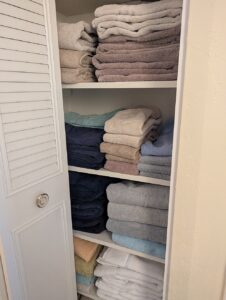
2025 Mar – How it started
I also amused myself by speculating whether this imposed order would hold up in the year we were absent. In the main linen closet, it held up pretty well. Not perfectly, but pretty well.

2026 Jan – How it’s going
But there was another closet: one with irregularly sized pool/hot-tub towels. And I mean irregular: some were about the size of a standard bath towel while some were seemingly designed for a natage à trois. After some experimentation (with the towels, not with group hot-tubbing) I settled on folding them into roughly equivalent widths and then rolling them into adjacent-to-neat bundles.
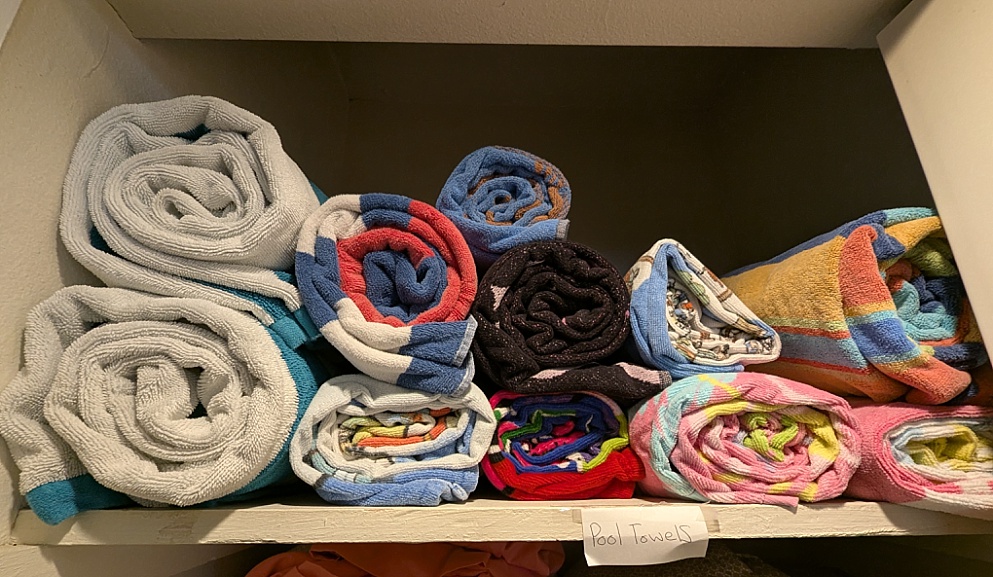
2025 Mar – How it started
I figured that this system would be more vulnerable to disruption than the more-or-less standard-sized bath towels, traditionally folded, and so it was.
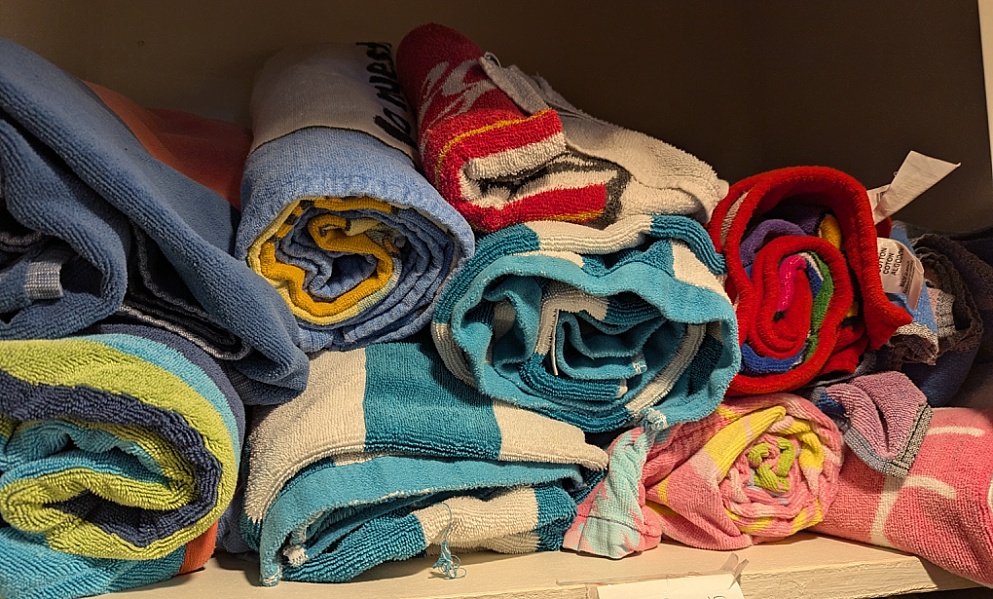
2026 Jan – How it’s going
You can still see the underlying organizing principle, especially if you know what you’re looking for, but the discipline of the original configuration has slipped. One towel is now folded, not rolled; some have lost their standard width; some formerly tight rolls have relaxed almost into shapelessness; and back in the corner, some (oh, the horror) seem to have just been stuffed up onto the shelf.
Does it matter? Not at all, but it shows how tricky it can be to maintain a system — any system, even one as simple as a stack of towels — when the member elements aren’t standard and neither are the maintainers. Between them, the renters and the housekeeping staff managed to maintain the order in the closet of regular towels, at least partly, I expect, because they could see the target at a glance. They lost the fight against entropy when it came to the pool towels because the target was less obvious and the method was more complicated.
It brings to mind the silent yet obvious systems we all interact with collectively:
- shopping-cart corrals
- condiment and cutlery counters at fast-food restaurants
- racks of clothing in stores
- packaged food in grocery stores
- books on bookstore and library shelves
- yarn on various unfairly enticing displays
Most of the time, the organizing principle is obvious and simple, whether it’s type/artist, brand, style, colour, size, or some combination of those in an equally obvious hierarchy.
All women’s discount clothing in this part of the store;
all pants on this rack, sorted by size with dividing markers stating that size.
Within each size category, we sort by colour or brand if time allows.
Their specific choices might not be the way I’d fold the towels, as it were, but I can usually see what they’re doing and I can help to maintain it, even if that just means not making things worse. And so I return the pants that were too short to the same place I found them, or to the right rack but hanging at the end so it’s clear they need proper re-filing, or at least to the right section of the store.
Indeed, depending on how clear the system is, how close it is to being perfectly executed, I might even move that novel by Robert Heinlein that I stumbled across under Fiction-R to Fiction-H.
However actively I interact with these systems–and it varies by the system and the day–their very existence is a marvel, a resistance to disorder by individuals and by society collectively, based on learning (and remembering!) which approaches work and which don’t. And it’s a marvel that I have the opportunity to push back against entropy, even if I don’t think of it in those terms exactly. A gradual decline into disorder may be inevitable at the level of the heat-death of the universe: at the level of my day-to-day, it’s a choice.

Order from our perceived chaos. John has left an 8-inch messy pile of rejected monoprints on rice paper in a corner of one of his studio counters — since 2011. Every house, no matter how orderly has “islands of untidiness” as a friend calls them. Are they the “happy dots” every painting/order needs? (Evidence of life lived, as John says.)
Re towel sorting, in a related matter, my mother had a friend who bought fitted sheets when they first were available, but since they would never look as neatly folded in her linen closet once they were opened, she gave all of them to her maid.
Barbara – There are now videos (likely whole YouTube channels) devoted to folding fitted sheets. I just choose not to look at my sheets when they’re not on the bed. As for “islands of untidiness” – I agree. In my living space, at least, there’s some middle course between a degree of disorder that brings anxiety and a degree of tidiness that feels sterile.
Your mention of the shopping-cart corrals turned my crank.
At the grocery store where I shop, you have to put a 25-cent coin in a slot to get a cart. It’s presumed that people will return the cart in order to retrieve their coin. Most do. A fair few don’t; instead they leave the carts in parking spots.
At Costco, some people just push their carts to the edge of the parking spots set aside for shopping carts, and leave them sticking out into the passageways.
Entropy reigns!
Tom
Tom – 🙂 Yup. I wouldn’t want the “close enough” shopping-cart returners with me on a mission to Mars, or any other precise (ad)venture!
Christine’s son and daughter-in-law both work for NASA. NASA is currently working with SpaceX — one will send the Artemis mission UP, and the other will bring it DOWN. According to them, NASA works with your categories of good order — trying to figure out all the problems that might be encountered and resolving them BEFORE launch. But SpaceX works more by trying something to see if it crashes, and if it doesn’t, then it becomes the accepted procedure or process. I personally tend towards order emerging from disorder and chaos, but I would certainly be hesitant about being sent out on a joint NASA/SpaceX mission!
Jim T – There’s a business (and software/product development) mantra, “Fail fast.” (Attributions vary.) It’s good advice in many things – but not in things where people’s lives are at immediate risk from a failure. Some environments support that risk taking, but many don’t.
Isabel – entropy, a term I hadn’t heard since my one and only university course in thermodynamics as a future civil engineer, low those many years ago. I understood the concept, but I didn’t understand why a civil engineer needed to be able to calculate the entropy curve between the water and the steam inside a sealed steam boiler.
Seemed more like a mechanical engineering thing to me.
John – IKR? Sometimes I feel like Peggy Sue who time-traveled back to high school as a middle-aged woman and told the math teacher that she happened to know she wasn’t going to need algebra.
Does anybody use algebra?
As a civil engineer, trigonometry yes, but not algebra.
John – I use ratios when adapting knitting patterns to a different yarn, but that’s a super-basic application. This site offers an enthusiastic rundown on who uses algebra.
Being of that age, I live in structure, simply because its simple, and makes my days easier…..not necessarily happier.
Breakfast: more or less identical for last few decades. Wash existing dishes while cooking egg whites and turkey sausage & coffee. Sprinkle with hot sauce and eat, leaving exactly 5 items to wash.
Make me happy, but a bit sad at the same time.
Eric – Yeah, too much of anything can be, well, too much. I think, too, that the right balance is different for each of us (between orderliness and variety) and (as you note) likely shifts as we age. But maybe it’s like what the personal trainers say about cardio versus strength training: the one you hate is the one you need. 🙂