
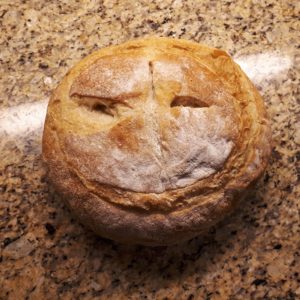
The soup was tasty,
but it was rich.
I stop myself mid-text. Have I chosen the right words? I take another look: soup, tasty, and rich are all correct. What I’m doubting is that but.
But often suggests an unfortunate trade-off between a good thing–tasty–and a less-good thing–rich. It’s what the book parody of The Lord of the Rings played on for humorous effect, lo, these many years ago now.
Hobbits are a short but nasty folk.
Well, it’s what they intended for humorous effect. Your results may vary. But the reason it might be funny is that it violates our usually unspoken and mostly unconscious assumptions for this construction: short but long-lived; short but smart; short but beautiful. In this case, both sides of the but are undesirable. There is no benefit that offsets the cost.
I look again at my text.
The soup was tasty,
but it was rich.
Is this really what I think? Would the Hungarian Mushroom Soup have been as tasty if I had over-ridden the recipe and gone with partially skimmed milk instead of whole-fat? If I had substituted low-fat sour cream for regular, or left it out altogether?
I think not. In some mysterious way, the fat was integral to the flavour. Of course the mix of spices mattered, but the fat mattered too and, I suspect, indispensably. Maybe I should edit my text.
The soup was tasty,
because it was rich.
But gives me a problem to be solved, if I can; because gives me a reality to accept, if I will. Before I launch on improving societal dysfunctions or my own failings or even the next pot of soup, maybe I should ask whether I’m facing a but or a because.

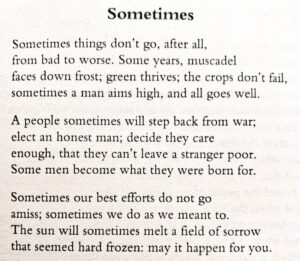
A friend once told me that every time I’m about to use a “but” I should try substituting an “and.” Most of the time, the substitution works, and avoids setting up an opposition.
Jim T – 🙂 Yes, that substitution does/can derail any reflexive impulse to contradict and open up the relationships we’re talking about.
Heard in California: No matter how hot it gets during the day, there’s nothing to do at night. No “but” but another kind of justaposition to ponder.
I like the use of ” but” because shows we can feel two things at the same time — the latter a little naughty in this current low-fat-is-better world.
What an interesting meditation on two vital little words! I am conscious in my own writing of the rational vs. emotional introspection that makes “but” a constant in my explanations. The left-brain wants to pontificate while the right-brain feels its emotional input is being overlooked. The ubiquitous “however” often substitutes for “but.” I wonder how often I simply need an “and”? I will be noticing.
Feel free to delete, but I had a long ago and not lamented boss who said “Everything before the but is BS”.
Mary – And I’ve used that phrase often – it’s not always true; it’s often funny.
Heaven forbid that you should change a Hungarian recipe! Our Hungarian guide gave us the recipe for the “true” Chicken Paprikash. When I blissfully told her I would sustitute coconut milk yogurt for the (of course full fat) sour cream, because I don’t eat dairy, her face showed horror at the desicration! To this day, I enjoy making and eating my inauthentic Chicken Paprikash.
Judith – 🙂 Now that’s funny. Obviously your guide didn’t subscribe to the notion that a recipe was just one person’s opinion. Mind you, a national dish might be the accumulation of a lot of opinions, I guess. But hey, if it’s good, go for it.
Hi Isabel, How about this: “It was a rich and tasty soup,” along the lines of Edward Bulwer-Lytton’s 1830 inspiration. It seems that the ‘but’ in ‘tasty but rich’ is leading the reader to self-recrimination in enjoying the taste of the soup and at the same time, lamenting its richness. Or, one could say, “the soup was tasty, and rich”, (emphasizing rich), and implying that the consumer of the soup was enjoying its delicious decadence darkened (dampened) slightly by a sense of doubt — “should I have eaten this soup?? it was so rich (and my doctor continues to nag me about bad cholesterol”.
Marilyn – 🙂 Yes, it can be recast in almost endless ways, it seems; even “Call me Rich” for the Moby Dick fanciers.
Isabel – might I suggest using “however” (without the quotation marks ) in your example to convey the message you are looking for.
John – I’ll consider that option for next time, for sure.
Isabel
Did Bilbo and Frodo and Gandalf, or just Golem, eat soup?
Tom
Tom – Hmm. I’ve read The Lord of the Rings about three times over a few decades and have no memory of soup. Was it from The Hobbit, by any chance? I never read that.
I don’t remember them eating soup per se, but at the start of the movie “The Hobbit” the dwarfs eat pretty much everything.
Tom
Tom – Ah, yes. If Golem ate soup I expect it would be fisshy ssoup.