Which came first,
the chicken or the egg?
This old puzzler has, apparently, been solved: Popular Mechanics (among others) tells me so.
When it comes to the simple answer to the question as it relates to Gallus gallus domesticus (a.k.a. the chicken), that riddle’s been largely solved thanks to evolution. At some point thousands of years ago, ancient chicken breeders chose two tame jungle fowl (gallus gallus) and the resulting union produced the egg of the world’s first genetically distinct chicken. In summary: egg predates chicken.
OK then. Now, we could go down a rabbit hole here (Which came first, the rabbit or the hole? You see how this can get out of hand.) and look at the implications of a 2024 article published in the prestigious science journal, Nature, and summarized in, you guessed it, Popular Mechanics: the less prestigious but, well, more popular magazine even if they do say so themselves. This article reports that some microbe that predated animals had an “embryonic process” resembling mitosis. So maybe the egg predated all animal life, in some sense, as weird as that sounds.
But we’re not going there. Instead, we are going to consider a related philosophical puzzler.
Which came first,
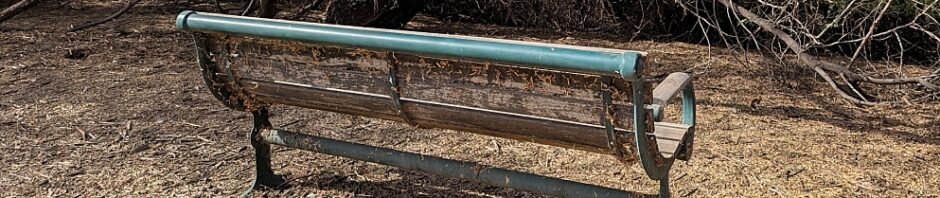
the view or the bench?
You might not think this is quite as tricky as the chicken/egg version. After all, who would install a bench where was no view? I’m glad you asked. I don’t know who did it–in this case, I acquit ancient chicken breeders–but I do know that someone did it.
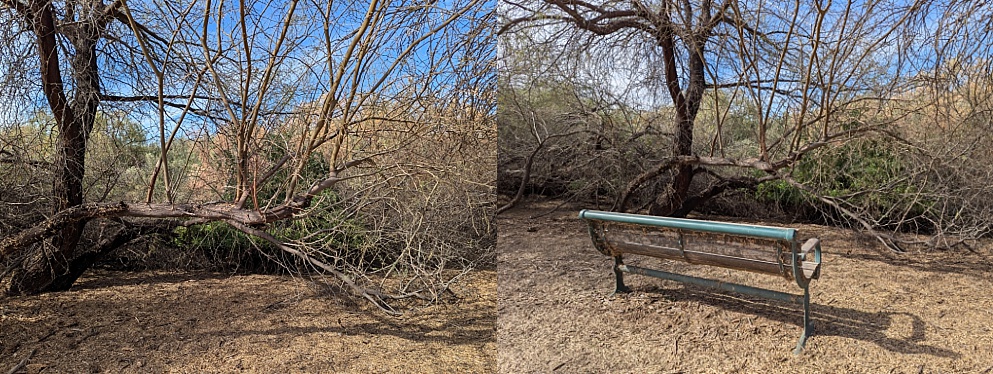
Now, to be fair (always popular), we could enquire about the history at play here.
Was there ever a view
at this location?
Like, maybe before the reeds and grasses growing along the completely hidden-from-view pond grew up to hide said view? Like, maybe before the tree branch/trunk bent over to fill in the eye-level vista for anyone sitting on the bench? Like, maybe. And if so, then it’s been a while since there was any view of any kind from this bench.
But as an occasional user of this park, my question is neither philosophical nor historical: it’s just practical.
Will there ever be a view here,
either again or for the first time?
If not, I’m thinking it’s time to move this bench to a view. Maybe I could get Popular Mechanics to write an article about it to drum up public pressure to do the right thing.
Why Popular Mechanics? I hear they have a lot of readers.
That tree can’t be a recent addition to the scene even if the reeds and bushes are. Any clues as to how long the bench could have been sitting there? Is it naturally that pretty turquoise color or is copper involved to create verdigris? Its situation seems bizarre, certainly. Is it a necessary resting spot for walkers, halfway between there and somewhere else on a journey? What other reasons than a view come into play? What is to be seen in other directions from that site? How many other benches like this are in the area? I’m sure you have already asked these questions and know the answers. A curiosity, for sure!
Laurna – All the other benches in the park are at places “overlooking” water (and birds and turtles) or play structures or plantings of cacti. I’d have expected a “rest bench” to be placed to face the path, not to put a rester’s back to it and the passers-by (uncomfortable). But the bench isn’t new – it shows signs of age/wear/UV damage. It’s possible/likely that the reeds and pond-side bushes have grown up since it was placed, and the tree trunk has tipped/subsided, further blocking the view, especially when it’s in leaf. And I expect it would be an effort and cost money to move the bench, which is why it’s still there. But it does look weird in situ! If the question were “Which lasts longer, the view or the bench?” I’d have said “The view” without hesitation, thinking of scenic overlooks and vistas in hilly country and mountains.
View is in the beholder.
Barbara – Well, that’s true. 🙂 Me, I’m thinking, “You can’t see birds from here. What the heck?”
Maybe a bench intended for those who want to have a private, non-distracted, conversation between themselves?
Or a place to meditate?
Or a lonely bench looking for a home (Free to a good home)
Jim R – There you go: all good options.
Which came first: the tradition on the bench or the iconoclast who sat down there?
Tom
Tom – 🙂
I think more relevantly, do other animal species ask questions? About chickens, or benches, or anything else. Because if they don’t, then the question becomes, “Which came first, the question or the human?” It would seem obvious that there has to be a human to ask the question. But maybe the question — any question — shaped the mentality of whatever became human.
Jim T – I’ve read about research that tries to assess various cognitive faculties in infants as young as 3 months by measuring how long they (seem to) pay attention to something. When something is not as they expect (something disappears from under a bowl, or a new person or animal comes into view, maybe even when the number of things changes), they pay attention longer. This is long before our intuition would suggest that an infant “could” expect a result. So maybe babies are asking questions almost from the get-go, in their own way.