Life? No.
Love? No.
Peace? No.
I’m running through the few Hebrew words that I can recognize when they’re printed without their vowels, the standard practice in all secular uses and in many religious ones. (Is it comms jamming? I don’t think so, but a language written sans vowels is a puzzle to me, for sure. But it is what it is. Onward!) Not surprisingly, these few words are the very ones most likely to be silk-screened onto a t-shirt or stitched onto a baseball cap. That matters, because it’s a baseball cap that I’m looking at.
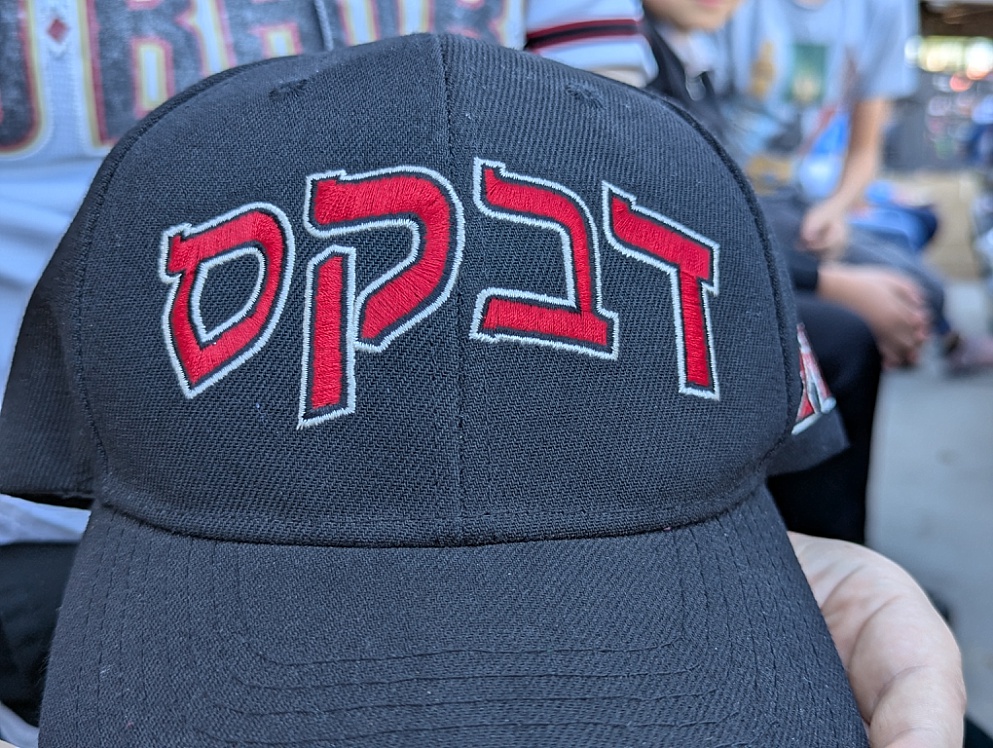
Eight young boys are sitting a few rows in front of us at the Salt River Stadium in Phoenix. They’re Orthodox Jews, wearing tzitzit and kippahs. One has a baseball cap over his kippah. Whenever he turns to talk to a buddy, I catch glimpses of the Hebrew lettering above the brim, but for the life of me I can’t figure out what the word is. Nothing obvious, for sure. I consider going down and asking him, but I hold back, a bit hesitant to engage with strangers and in a strange land, to boot. How would that go?
Hi, you don’t know me
and have no reason to want to,
but I’m new at being Jewish
and I can’t read your hat.
Yeah, no.
But a few innings later, I see the kid in the concourse with one of his buddies who’s wearing a Toronto Maple leafs cap. Aha! A Canadian connection of some unspecified sort: it ain’t much but it’s enough to overcome my hesitation. I flag them down and tell them I’m from Canada, I’ve converted recently, I’ve noticed the hat, but my Hebrew isn’t great. I can tell from their faces that they’re keeping up with this slightly disjointed series of statements, but only just, and are maybe a little anxious about where it’s going. I could start again but decide it’s better to keep going.
What does your hat say?
Now I see relief: This, they can answer. “D’backs” the one says – short for the Arizona Diamondbacks, one of the teams we’re watching that day. I’m tickled. It’s that thing where we use just the sound of the letters to approximate a word in another language: it makes sense only when you say it aloud. When we’re all back in our seats, I go down to get a picture . . . and he gives me the hat, just because he can see that I like it.
This little feel-good story, though, has a less-happy postscript. I end up texting with one of the fathers who brought the boys to the game. He never heard me identify as Jewish, so when I comment on how lovely it is to see a kid who has a kind thought and acts on it, he tells me that developing this quality is a focus of their Orthodox community and asks me to consider telling the story to my friends.
Maybe you’re not on social media,
but we’ve been facing a lot of antisemitism lately.
Yes. I’d noticed.
And so I have been telling this story, in different venues. Will it make a difference? Will the kindness of one Jewish/American/baseball-fan pre-teen to a Jewish/Canadian/baseball-fan senior change how anyone thinks of Jews? I don’t know. I kinda doubt it. But it’s already changed how I think. Now, when I’m tempted to despair about the state of the world, I’ll think of a 12-year-old met in passing, a selfless act of kindness, and a whole community that is deliberately fostering that kindness. I’ll look at that דבקס/D’backs baseball cap that is now mine, and I’ll try to do something kind myself.


GREAT STORY
thank you 🙂 (I couldn’t find anything lower than lowercase.) For sure the interaction made my heart glad – and still does. Glad you liked it.
Okay, try this phrase with no vowels…and also, because the original writing was on either papyrus or animal skins, no separation between words.
Gdsnwhr.
Tom
Tom – Left to right or right to left? Not that it likely matters: I don’t think I can decode it.
Left to right. And there are two possible answers.
Tom
Also, it’s two words in one solution, three words in the other.
Tom
Tom – OK, one two-word solution is God’s nowhere. And I guess that could be a three-word solution: God is nowhere. I don’t see no others, no how. 🙂
Not only heart-warming but fascinating. I knew the reading right-to-left. I knew the absence of vowels although I cannot understand how one can deal with all the possibilities that must lead to, word by word. The transliteration into another language is a big surprise! And, yes, the world is a mess, but I think we were warned about that a long, long time ago in a story or two. Something about Eden and a flood and . . . .
Laurna – Hahaha – yes, we’ve maybe had a few warnings. As for the potential mix-up of words, some commentaries by the early rabbis riff on these. The letters for matzah (unleavened bread) and mitzvah (commandment) are the same. I forget what lesson they derived from this coincidence. Some student I am – remembering the example but not the point! Also, I think I read recently that the vowels were a later addition, to help communities that had fallen out of familiarity with Hebrew say the words correctly. That suggests they didn’t start with specified vowels (or with any markings to specify them) which does seem amazing.
I apologize. I erred.
God is nowhere. (3 words)
God is now here. (4 words)
Tom
Tom – Yes, I see it now. 🙂 It occurred to me later that “God is anywhere” would also fit those consonants – but it wouldn’t be super meaningful.
One of my favourite words to learn the last few years is; Tzedekah. This is a small sample size of that.
When I first learned the term it was from a video of the aftermath of a Tornado passing through, Kansas City?, and the Jewish owner of Home Depot threw open the doors to the store, giving away chain saws, generators etc. To top this off, the doors remained open, with kennels, to take in dogs who has lost their homes and were separated from their families. I love that word.
Ken – Let me add “chesed” – kindness(es). It’s a word that is often paired with tzedakah.