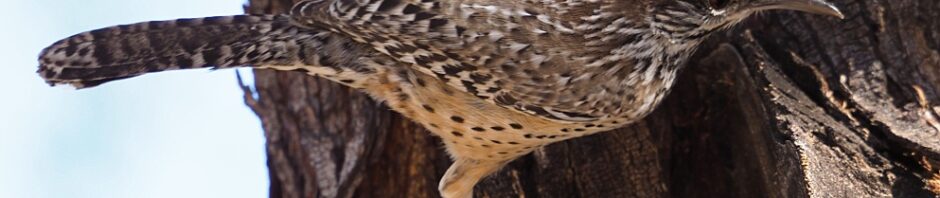
There are, I come to find out, 88 species of wren. That’s certainly enough to defy simple categorical descriptions, and in this they do not disappoint. Consider these facts:
- All 88 species are found in the New World, except for the one that isn’t: the Eurasian wren.
- In the New World, they live in almost every habitat: forests, deserts, and grasslands.
- They mostly eat bugs, spiders, and other small invertebrates, but they’ll also eat seeds, berries, and occasionally small amphibians like frogs or tadpoles.
- They can be quite bold or very secretive in nature.
- While most wrens are non-migratory, some that live in temperate zones do migrate, but not all.
- The Eurasian wren hangs out around people, but other wrens are solitary.
So, to summarize, wrens live here and there, eat this and that and that, are in-your-face unless they’re hiding behind your back, stay put through the seasons unless they don’t, and are extroverted unless they’re introverted. And, oh yes, some non-wren species have been mistakenly identified (and named, of course) as wrens.
All right then. How hard could it be to identify a wren?
Well, with a photo – even a slightly blurry one – it wasn’t hard at all for Merlin to identify a bird I saw on a walk as a cactus wren.
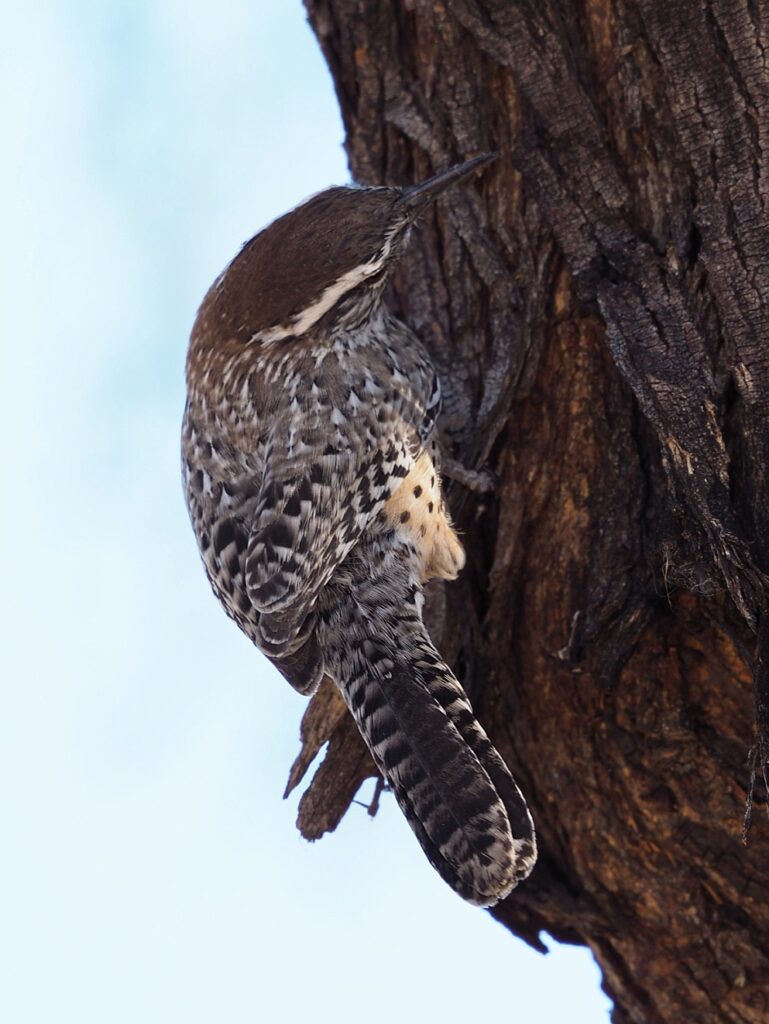 One of the other facts about wrens is that they have drab plumage. Well, OK, the colours aren’t exactly bright but the throwaway line about them having “barred patterns on their wings or tails” seems to under-sell this little guy’s plumage.
As he circled the tree trunk, heading ever upwards, he wasn’t the ideal photographic subject. A brief sojourn in the sun and without movement was all I asked for. It was not what I got. I hear from other bird watchers/photographers that this inability to stay still is, perhaps, the one truly universal truth about wrens.
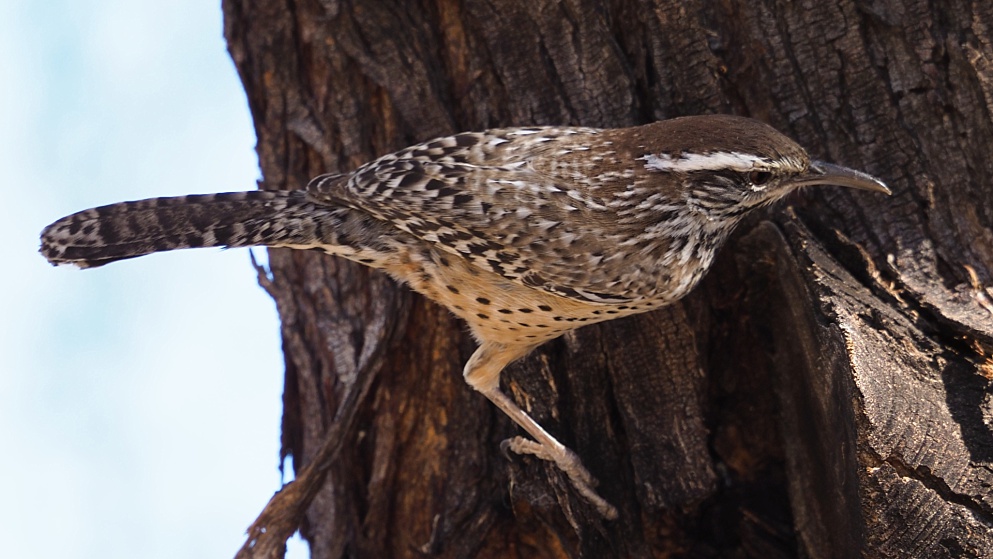

Was ‘he’ a ‘he’ or a ‘she’, and might the plumage differ between them?
Mary – It turns out that they’re the same. Cornell Labs says, “Males and females look alike, but juveniles are slightly paler and have a brown eye.”
With 88 species of wren on the wing, even I could appear to be a bird watcher with a glance at a brown-barred cutie by announcing, “Oh, it’s a wren!” I am astonished at the variety and in awe of its adaptation to so many different environments and food sources. Your patience in capturing its photos with all that flitting about is impressive, too. The wonderfully textured and sunlit tree trunk in the background also makes me think about painting it. I have an attraction to trees, which figured prominently in my compositions when I was painting. Something about taking the time to notice detail clearly enough to reproduce it in a medium like oil paint is nourishment for the soul.
Laurna – Yes, I think “Oh, it was a wren” is a useful dodge for those of us who aren’t bird experts. The other rule I know is from my brother: Call them as they leave – with “call them” meaning, give your ID out loud. It’s hard for anyone to dispute that sort of identification.
Good to know we have a wren expert amongst us now.
And your thorough notes taught me something else. The fairy-wrens in Australia, which I thought were wrens, aren’t wrens. They look like wrens but I looked them up when you said all wrens are drab, as fairy -wrens are anything but. And discovered they are not wrens.
So thanks for the education re wrens and some non wrens
Jim R – Well, my wren expertise was on exhaustive display in this post. I’m glad you got fairy-wrens in the right bucket.
And there I go…things I didn’t know about wrens. Thanks, Isabel.
Tom
Tom – 🙂 Happy to help. So much to learn . . .