
Uh, oh. Here we go again.
As we walked around our new neighbourhood last week, getting exercise, our bearings, and photos all at once in a virtuoso display of stunning efficiency, I found a climbing vine that had gone to seed. It was wrapped around the branches of a mature spruce tree adjacent to a golf-course club house in an area without much sign of careful tending. It also looked familiar.
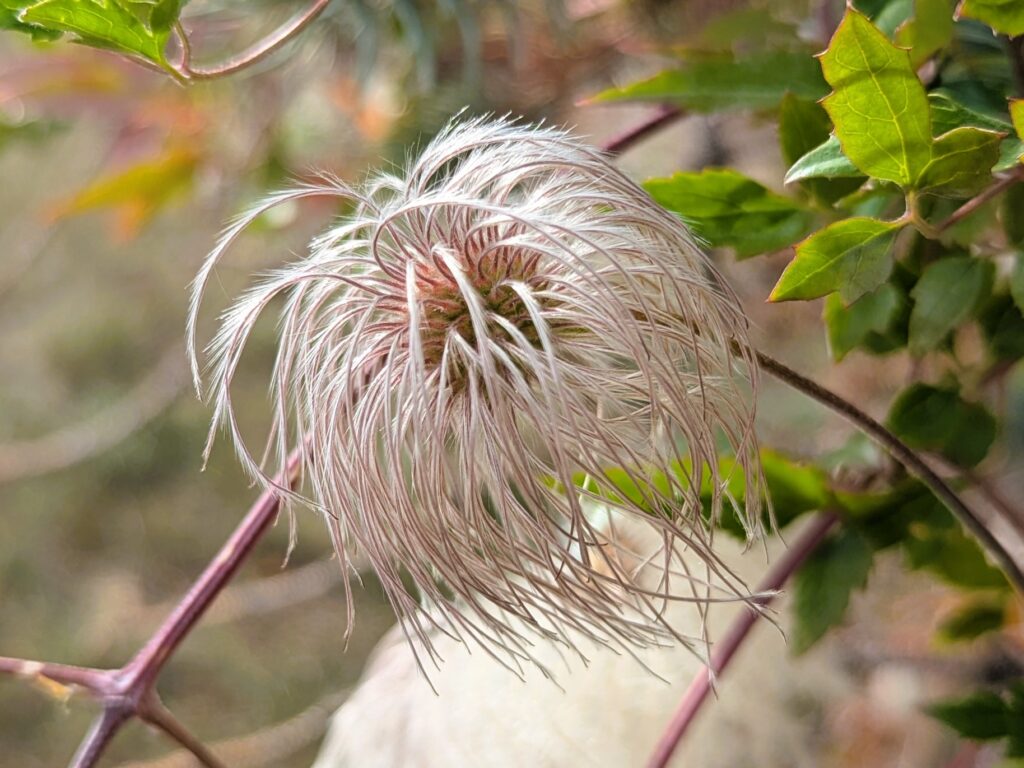 Looking at the photo at home, I wondered whether it could it be a clematis, and yet that seemed unlikely. In my experience a clematis demands careful planting: adjacent to something vertical to cling to and to climb up, sheltered from cold winds but sufficiently open to sun, and provided with a rock cover to protect the root ball from excessive heat. And yet, this wild-growing vine had produced seed heads similar to the pampered clematis in my former backyard.
Google Images confirmed my guess, so I went back the next day to get a better look.
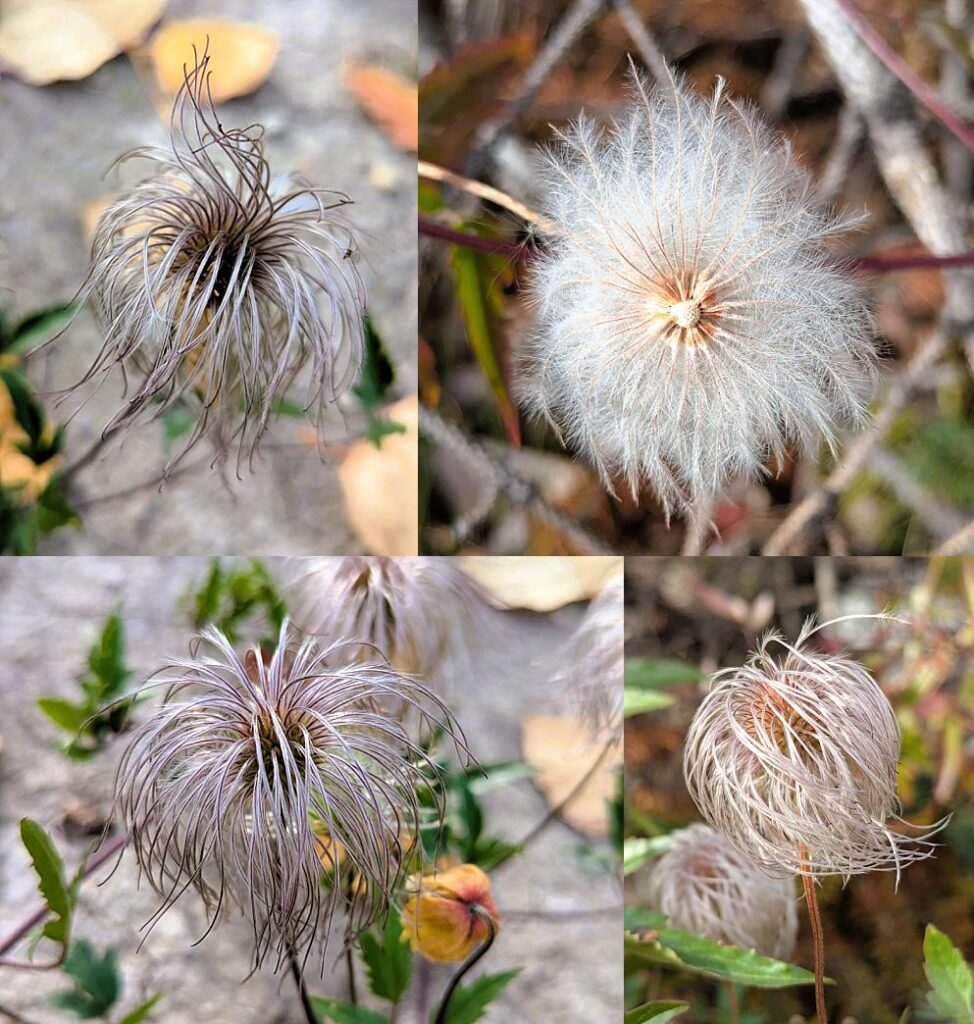
There were a bunch of clematis(es): winding around the spruce’s branches, straggling along an old stump, and slithering through the grass. So much for rigorous planting requirements. Were these by any chance a hardy native clematis, a little less precious in their needs than my landscape-centre purchases, optimized for bloom size rather than toughness? That would be a cool find, indeed. Back to the internet.
And the answer is . . . maybe they’re a native species. But they also might be an invasive species, Clematis tangutica. Oh no.
Just from the pictures of their seed heads, I can’t tell the difference between the native species I ought to encourage and the invasive species I ought to eradicate, or try to, anyway. Invasive species are naturally good invaders, remarkably resistant to even a discouraging word. So, I’ll have to go back in the late spring to check out the flowers.
It’s good to have a photographic subject, a civic project, and a purpose for a walk, all in one. Talk about your efficiency.
Breathtakingly beautiful photos, Isabel! The banner flower is spectacular. And just when I was thinking “gamin haircut” of your clematis, that aging-like-a-dandelion but with peacock feathers in mind blew me away. I don’t want to stop looking. They are marvels of delicacy, motion, and subtlety with such elegant, dignified colours. Thank you for taking us along for exponential efficiency.
Laurna – Many thanks. They do seem akin to a dandelion, don’t they? And yet not… I’ll be fascinated to see what colour blooms they produce next summer.
Wish my clematises/clematisi(?) would grow so healthily……
Fletcher Wildlife Gardens, in your former hometown, has clematis growing profusely over an arbour. I know they wouldn’t plant an invasive species – I’ll have see if I can find out what theirs is. Can’t say I’ve ever seen it blooming
Jim R – I like one of the Hebrew plural endings: -im. That would make it clematisim, I guess. 🙂 I think I need an expert to look at my photos – it seems to be a subtle distinction. Of course, if they grow yellow flowers in the spring/summer, that will pretty much tell the tale.
What beautiful photos, Isabel.
Thanks.
Tom
Tom – Thanks, Tom – and Happy Thanksgiving. Today, as Judith noted, everything is under a few inches of snow.
Isabel – plants have a will of their own. They grow where they want. Sometimes in the most improbable places.
And if they are growing where you don’t want them, they are weeds, regardless of how beautiful they may be.
John – Fair enough.
There was a cartoon character who had hair like these clematis. I wish I could remember his name. Was it in a Dr. Seuss book? In the L’il Abner strip?
Jim T – Hmm. Ringing no bells here, so I asked Google what character had hair like a clematis gone to seed. Bob Terwilliger from the Simpsons (which I never saw) came up. Could it be him?
Or it could be the Truffula Trees from The Lorax.