We used to call them canaries.
The speaker? My mother-in-law.
The time? Oh, maybe 20 years ago.
The expression on her face as she looks out the window at a swarmed-by-yellow-birds feeder in rural Manitoba? Pained.
Now we have to call them finches.
Her tone clearly signals impatience with newfangled silliness, a point of view that I understood in theory 20 years ago, but that makes better sense to me now.
And until just now I thought the renaming of “canary” to “finch” was one of the many cases of DNA analysis correcting initial classifications based on casual (and mistaken) field observations. Or, a little more formally . . .
The taxonomy of the family, in particular the cardueline finches, has a long and complicated history. The study of the relationship between the taxa has been confounded by the recurrence of similar morphologies due to the convergence of species occupying similar niches. – Finch
Yeah, that’s what I was thinking: DNA analysis is unconfounding errors based on deceptively similar morphologies and, um, niche convergence.
But this whole canary/finch thing is not a part of that. What was I thinking? Nothing very smart, evidently. After all, see what snippiness emerges in the AI Overview when I ask what seemed like a perfectly reasonable question: Are canaries called finches now?
Canaries are not “called” finches now; rather, a canary (specifically the Atlantic canary, Serinus canaria) has always been a species within the biological family of true finches (Fringillidae).
Amazing how much tone can be carried by scare quotes. All right then: canaries are not “called” finches; they *are* finches. But do they appear at bird feeders in Manitoba, Mr. Smarty-Pants? This time my answer is more matter-of-fact.
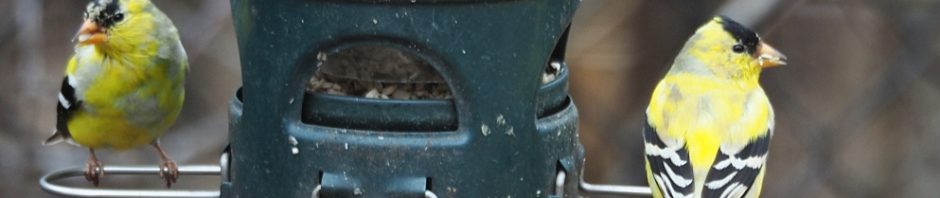
Now, as far as I remember, the yellow birds we saw that long-ago day had no distinctive black wing markings and black caps, ruling out the American Goldfinches (seen on my own backyard feeder in the header photo). In Manitoba, that apparently leaves Northern Yellow Warblers, which are “uniformly yellow”.
We used to call them canaries.
Now we have to call them finches.
So. Did we once call Northern Yellow Warblers, “canaries”, and incorrectly so? And do we now call them “finches”, grudgingly in some cases and incorrectly in all?
It could be, and I guess that could be “called” progress. Or maybe niche convergence. I’ll have to check with AI.
Isabel – and do you want a ‘bunny-hug’ with that as well?
One person’s ‘yellow canary’ or maybe ‘wild canary’ is another person’s American Goldfinch, if that last person is NOT one of the locals used to seeing yellow canaries or wild canaries, preference depending. Local usage can be a tricky thing, but if it works for the locals ….
As a teen I hunted ‘snowshoe rabbits’ in the winter, knowing full well that they were actually ‘Varying Hares’, but in the area where I grew up they were called ‘rabbits’.
John – A fair point. Regional variation is how one tree gets a multitude of names (tamarack, hackmatack, and too many larches to cite), as we saw just recently.
Who knew? Apparently no one.
But the last place I will go for “information” is AI. The elimination of expert opinion in exchange for a soup of facts extracted from a machine with no moral compass and no actual neurons is not an improvement over encyclopedias including the much maligned Wiki, in my opinion.
Laurna – If there’s a way to turn off the AI Overview on searches, I haven’t found it. But I read that more and more people are stopping at the summary/overview and not “clicking through’ to the source material. As you note, not a good idea.
I agree with Laurna — but I did have to laugh at one of the telephone robots the other day. It said, “Please hold and I will try to connect you.” TRY? Are they getting as fed up as the rest of us in the difficulty of communicating in this Age of Communication?
As for bird nomenclature — to me they are all just “birds”. Sorry. But I do know pigeons. About a hundred fly around our high rise (we are on the 22nd floor) in their exercises every 40 minutes in winter. As they flew by in close “formation” I opened the balcony sliding door and heard them go by: Their wings sounded like gently swishing silk skirts. Lovely.
Barbara – 🙂 Maybe we can get even with the little AI beggars yet, eh? As for knowing birds, it’s a slippery slope. One day you’re enjoying the sound of pigeon wings en masse, and the next thing you know you’re booking a trip to see a rare bird. The good thing is that every step along that slope is its own reward.
Perhaps this is the finch in the taxonomy gold mine…er, coal mine!
Ian – 🙂 Thank you! I had intended to work that expression in somewhere/how, and then forgot.
How about “little yellow birds”? Misnomers are fine, depending on your audience. On our group walks, some of us say, “Oh look at the little yellow bird!” and some knowledgeable types say, “Yes, there are a lot of finches around just now.” All nod.
Judith – That works for me. Nodding wisely is also good.
Following up on Judith’s “little yellow birds”, we see lots of LBJ’s when out walking through the woods. “LBJ”= little blue/black jobs”. Maybe we need to add LYJ’s.
I remember being taught yellow canaries when I was many years younger, but learned to accept (American) Goldfinches by mid-life.
There have been other birds/plants/insects whose ID’s have changed over the years. My tired brain can’t come up with the other examples right now (But will likely tomorrow when it is too late).
Jim – And I learned LBJs as “little brown jobs” – it’s just possible that it depends on the birds in your area! I’d kinda enjoy it if there enough small blue birds around to warrant an acronym.
Isabel
Canaries coming from the Canary Islands reminds me of the story…
A man reporting on a sailing trip said, “We first sailed to the Canary Islands and were surprised to learn there were no canaries there. Next we sailed to the Virgin Islands…and were surprised to learn there were no canaries there either!”
Tom
Tom – 🙂 Much witty humour and wordplay rests on surprises or overturned expectations like that. I wonder if it’s the adult extension of infants laughing in reaction to surprises – seeing things they didn’t expect, or things that are out of place. A silly face or a hat on a foot isn’t humorous for adults – but it can be very funny to a baby.