
Is it full? I can’t tell.
I don’t think so. The left side looks a bit flat.
How many times have I had this conversation or its rough equivalent while staring at a full-ish moon? A few dozen times, at least. Unlike those who know the moon’s phase for spiritual purposes, unlike those who know the moon’s phase for scientific/meteorological/navigational/calendrical purposes, I just go by what I happen to see. I’m pretty sure I couldn’t lay out the moon’s phases in order, and for sure-sure I never know when a full moon is coming. This is, perhaps, one of the costs of living under a roof rather than under the stars.
On the other hand, a full moon is always a delightful surprise, as it was two nights ago on Sep 24. Of course, I wasn’t sure whether it was really full or just mostly so.
Is it full? I can’t tell.
I don’t think so. The left side looks a bit flat.

Once inside again, of course, a quick Google question settled the matter: it was just mostly full, because the full moon was scheduled for 10:49 AM MDT on Sep 26.
Again I wonder whether the learning I absorbed justifies the taxpayer dollars spent on teaching me for 12 grades, because I was this many years old when I learned what I can’t help but feel I should have realized much earlier; to wit, that the full moon has a peak that can be timed to the minute. Once you get *there*, of course, you have to wonder whether it can be timed even more precisely.
While the mathematical calculation
can theoretically be extended
to the second or millisecond,
calculating it to a specific second
becomes physically and observationally meaningless.
Setting aside a vague disquiet about my possibly wasted youth and abjuring even a vague interest in calculations either physically or observationally meaningless, I am left with two thoughts.
First, it’s kinda pointless to expect perfect. Perfection is fleeting: after all, even the heavens themselves are in constant motion.
Second, it’s entirely reasonable to expect beauty. Beauty is enduring: after all, for every minute of peak-full-moon, we get two to three nights when the moon appears full enough to the human eye that we can stand around arguing about it.
Is it full? I can’t tell.
I don’t think so. The left side looks a bit flat.
Maybe I can’t tell, but for sure I can enjoy. Truly, I am blessed. So are we all.

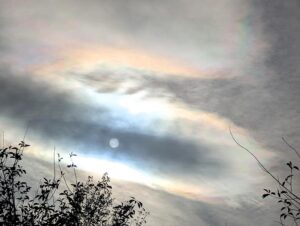
I absolutely concur about not being able to be sure about the fullness of the moon. Your photos are a delight. I love the way the night lights of the city curve into the night light in the sky. That aura in the clouds is special and not so often caught in a photo. You have so much more sky to contemplate!
Laurna – Many thanks. I’m really enjoying the expanse of sky available to me here. I mean, technically, Ottawa-writ-large has the same amount of sky as Calgary does, but our location here is much more open.
Only modern navigators and some scientists need to know when the moon is definitely full. The rest of us can relish the beauty of the moon in all its phases (whatever they are). The cloud aura in your photographs is wonderful – literally makes me gaze in wonder at the infinity of the sky.
Judith – Thank you – I’m glad you liked it. Let this serendipity encourage me to take recyclables out to the curb for pick-up routinely or even a little more often – that’s the only reason I was Outside At Night.
This made me smile Isabel! I was last-year years old when I realized how much the moon position in the sky also changes.
I’d share a pic of the beautiful Harvest Moon from the Okanagan Lake waters (our Dragonboat team did a full moon paddle last night), but alas, I don’t think that’s possible here. Suffice it to say it was awe-inspiring. As are your almost-full full moon photos.
Carla – IKR? And what’s with the moon being “up” in the daytime? I’ve read that observatories get calls from concerned citizens every time that happens. The things we don’t know . . .
In reply to Laurna: “our location here is much more open.”
Looks like you are now at the top of the hill not the bottom like in Ottawa. Although looking at the pics I wondered if you were not atop Nose Hill.
Nice pics too!!
Advantages of taking out the recycles
Jim R – We’re partway down a hill, I think – but way above the lowest point and not much development right behind us. And Calgary’s ring roads are wide open, with broad vistas in at least one direction, most of the time. The rolling hills that border the city to the west provide different viewing opportunities than Ottawa’s relatively flat terrain with just a river valley cutting through it.
I’m no expert either, but the moon certainly looked “full” the last couple of nights.
Shine on, shine on, regardless…
Tom
Tom – Well, shine on, indeed. Sometimes I think I can detect a slight flattening; sometimes not. But “close enough” often carries the day. Or night, as the case may be.
Isabel – but can you tell if a crescent moon is waxing (growing towards becoming a full moon) or waning from having recently been a full moon?
If you look at a crescent moon and it takes the shape of a “C”, “C” stands for coy and the moon is going into its waning/hiding phase,
If you look at a crescent moon and it takes the shape of a “D”, “D” stands for daring and the moon is revealing itself more and more as it grows/waxes into a full moon.
All of the above was taught to me by an air navigator friend.
John – That’s a cute mnemonic. Thanks!
Easy to remember too!
🙂