
That doesn’t look
like a winter cloud.
As I get into the car, I’m making explanatory and exculpatory-of-self noises for the delay. I had glanced innocently at the sky and stopped dead in my tracks. For the first time this year, spring was overhead.
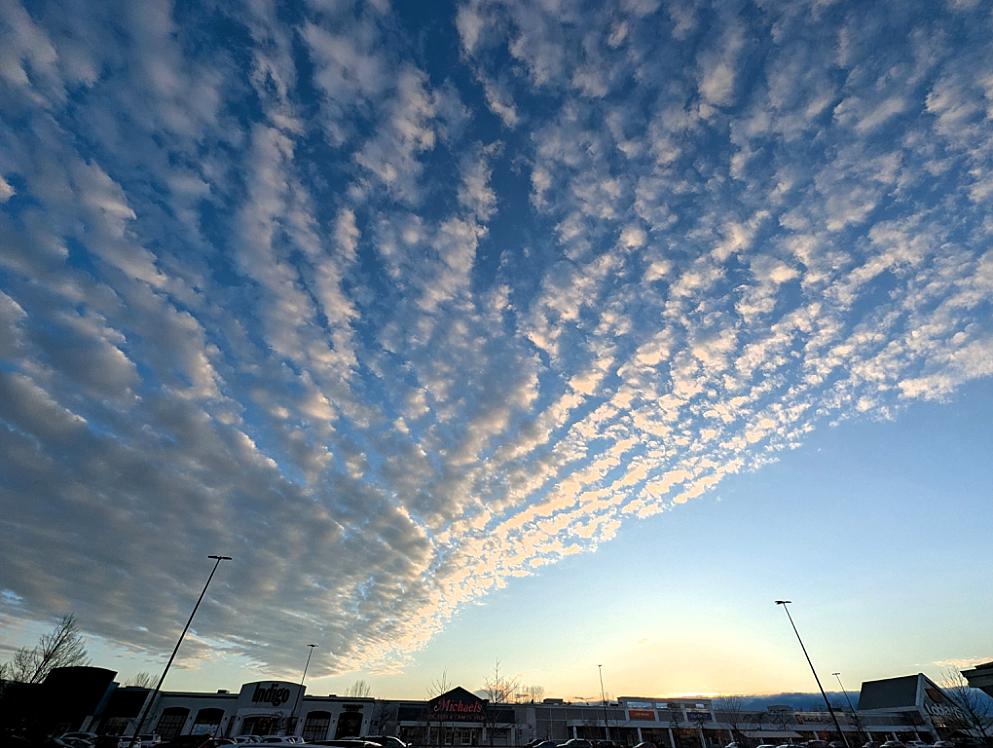
As soon as the words were out of my mouth, I wondered (yes, yes, a little late to need) what they meant: Do clouds really look different at different times of year? And even if so, generally, was I right specifically: Did these clouds look like spring?
To the first question Google gives a clear “Yes”:
- Here: Why Winter clouds are different from Summer clouds
- Here: Clouds have seasonal differences
- Here: Do cloud formations change depending on the season? (Warning: The answer uses concepts like radiative forcing.)
Are my clouds spring-like? That, alas, is not as clear, even though I did rigorous research on the topic by looking at two articles:
What’s the short form, minus the jargon? Summer clouds tend to be puffy; winter clouds tend to be flat, top and bottom. And spring clouds, which is, ahem, the point of interest here? Transition seasons tend to have a mix of summer and winter clouds. That seems fair, since our temperatures have been a mix of summer and winter, too, bouncing between almost-shirt-sleeve-worthy and cold-to-the-bone, but it doesn’t help me visualize what that mix of clouds would look like.
I can see spelling mistakes at 10 paces, but can I distinguish the muddled continuum of real-world clouds based on textbook/extreme examples of each cloud type? Not so much, and truly, I am no wiser for having looked at these articles. What I wanted was perfectly reasonable: my photo used in one of these articles to illustrate a typical spring cloud. I did not find that.
Did you ever notice that it’s hard to find the exact information you need in the format you want it in, to answer a specific question? The internet is great and all that but I’m beginning to think there’s a role for a human guide here. I’m really not interested in making the effort to get sufficiently up-to-speed on clouds that I could be confident in categorizing this particular cloud, but I’d be happy to pay for 15 minutes with someone who is already at that speed. It’s a general problem, I think, whose solution could be an online trading post, where the credit I earn for contributing spelling-mistakes-identified-at-1o-paces would pay for someone else’s contribution of clouds-categorized-while-you-wait.
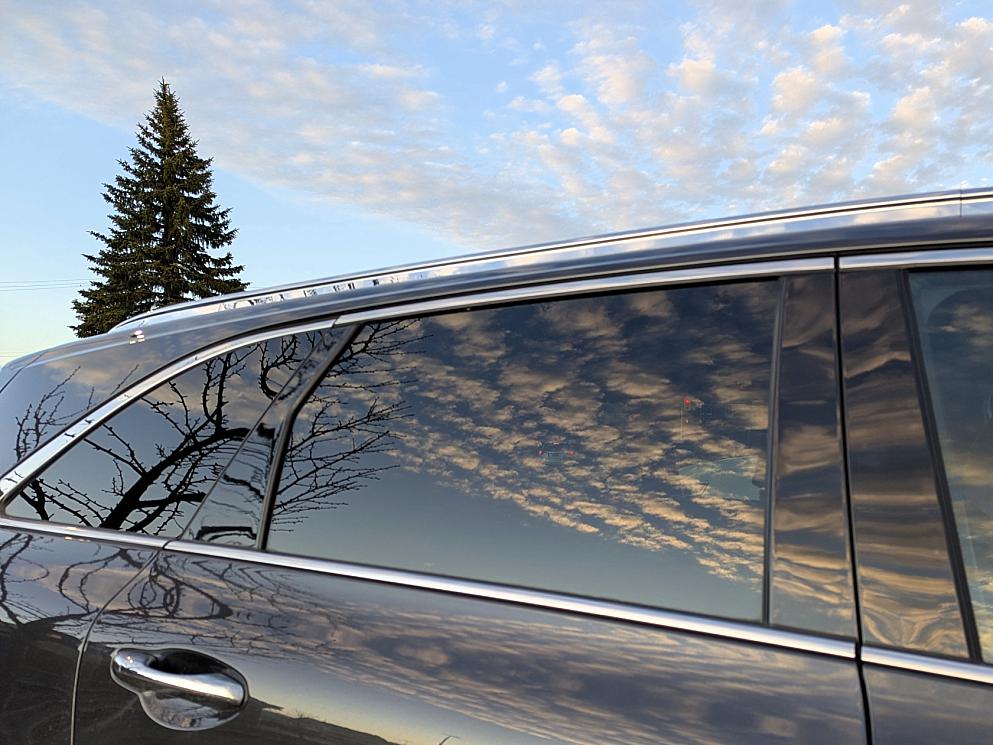
In any event, in the absence of said guide or trading post, I did find a nice reflection of whatever kind of clouds these are (a reflection not in any way less wonderful by the photographer not being sure about the season of which the clouds speak), so there’s that. Some days, that that is enough.


“But I’d be happy to pay for 15 minutes with someone who is already at that speed.” Now there is an idea whose time has come! Experts of all kinds on call 24/7 for just 15 minutes of their time. Not in real time, but in recorded time. With real voices and/or visuals. You Tube helps, but is not specific enough, has too many gaps, is poorly organized, and is not curated. Experts could create 15-minute clips on their areas of expertise on a Wiki-like platform, with opportunities for upgrades as needed. This teaching and learning opportunity would feature human input fairly rewarded, featuring opportunities for feedback and correction. It would provide a corrective to AI by identifying and rewarding the human input while allowing the recipients to make comparisons and to exercise their own judgement. Oral communication can be far more efficient than written communication so that more information is compressed into the time interval. Aspects of this kind of information are floating around the Internet already. Someone could start with a better organizing system and add to it.
Laurna – 🙂 That could be a milestone on the path to interactive sessions. I want to be able to show someone my photo, not look at theirs!