
Not, you note, “Bees sweat.” Bees do not sweat. Neither, apparently, do insects in general, a fact I confirmed through rigorous Google search. The only exception Google found for me? The arid-land cicada.
Unlike mammals, which regulate body temperature through metabolic heat production or sweating to cool off, insects must use behavioural adjustments
(Ed’s note – flapping wings or hanging out in shady areas) to reach their desired body temperature. – Journal of Experimental Biology
All right, then. Bees, sweat. What do I mean? Based on my extensive bee knowledge, I’m thinking like an index:
Bees, honey
Bees, killer
Bees, sweat
They are usually called sweat bees, although I prefer to emphasize the bee, not the sweat.
Anyway, when I put those index categories down I realized that I didn’t know whether there are any more. As one example, where do bumbles fit? Back to Google! I found two classification schemes for 7 bee families (or 14, maybe, I just love settled science) encompassing more than 20,000 bee species worldwide:
- Social versus solitary bees
- Short-, medium-, and long-tongued bees
Sweat bees are solitary, medium-tongued bees, and they get their name not from sweating themselves but from being attracted to the salt left behind on our skin from our sweat. The singleton sweat bee I saw this past week, however, was not licking salt off my skin with its medium-length tongue, hurray, but was instead gathering pollen. Bees, I come to find, gather pollen intentionally as a source of protein, vitamins, and minerals; wasps gather pollen incidentally when drinking nectar. I found no reports of wasps licking salt off humans but I wouldn’t put it past them.
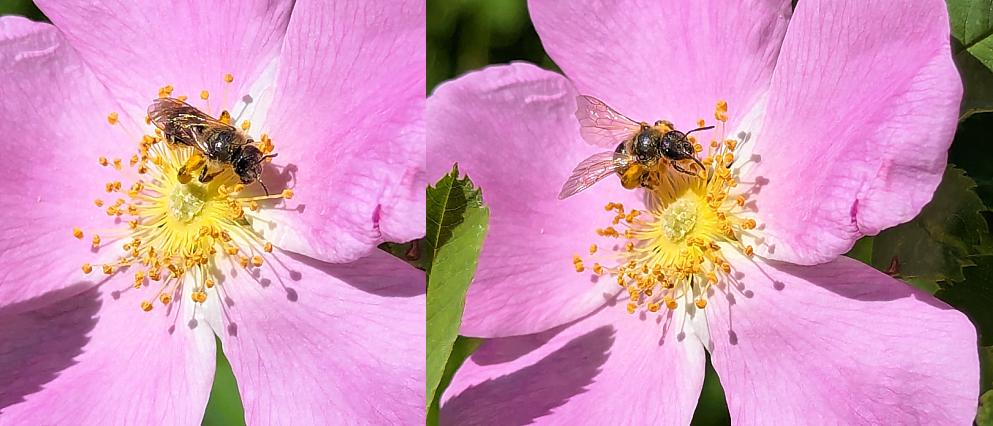


Astonishing to learn! I devoted some time this week to hornets, which are a sub-order of wasps, of which there are tens of thousands of species. Something about bees and ants occurring within those sub-orders — but I’m already way out of my depth in classifications. The idea of “families” might rescue some of my floundering. It is interesting to know why those pesky little solitary critters are attracted to us.
Laurna – Yes, the natural world is ridiculously/amazingly complicated. Pull a thread anywhere and it unravels for miles.
Well done on recognizing the sweat bee on the flower! Bees love my hollyhocks, and I watch them intently. Don’t know what kind they are. Fascinating that they concentrate totally on the flowers and ignore me, who is obviously not much of a food source. Except, it seems for sweat bees.
Judith – In truth, Google Images did the heavy lifting on the recognition front. 🙂 Considering how many kinds of sweat bees there are, though, I’m going to start guessing them whenever I see a small bee. And I’m with you – who even thought that bees might be landing for salt and not for stinging?
I have never desired to get cuddly enough with a bee to see if they sweat!
The little whelps used to get in my bedroom in the farm home where I grew up…left a lifelong impact.
Tom
Tom – I enjoy photographing bees that are intent on gathering pollen; otherwise I’m happy to avoid them.
Thank you for the trip down the rabbit hole of bees!!
Jim R – 🙂